The Xenoase series
An archive for the overlooked
The largest body of Varga's work honours African lives in Lusatia — and in 2025 it became the subject of the first academic study of his practice.
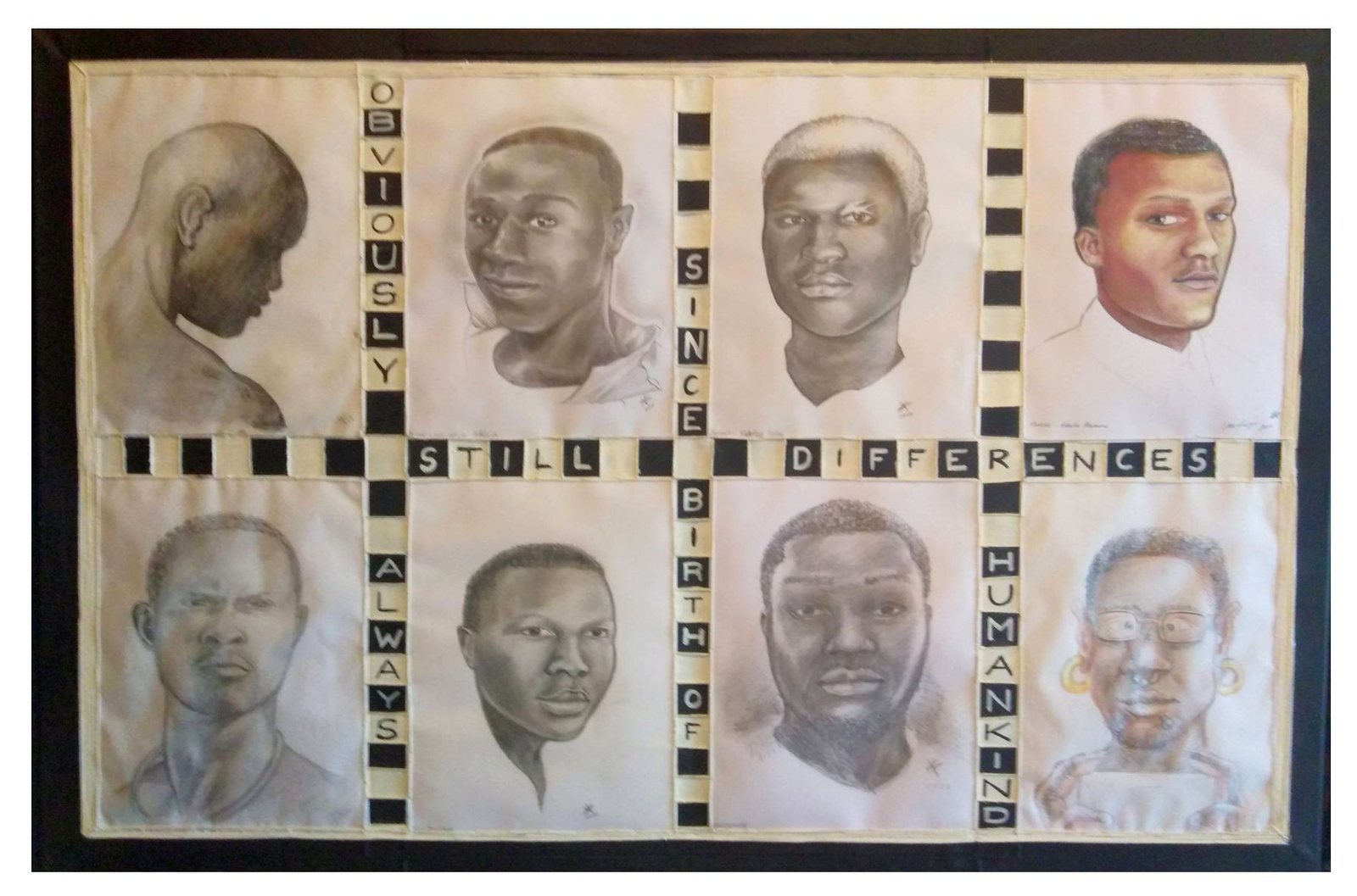
Thirty-eight of the sixty-one works belong to one series: Xenoase, the heart of the archive. Figures, flags and pictographic borders honour African lives and the African diaspora in Lusatia — portraits in graphite and coffee, Kenyan flags painted twice, and canvases of hand-copied Bamum script, the alphabet invented in Cameroon under King Njoya around 1896.
The work is not decoration. Differences sets eight graphite portraits of Black men into crossword strips reading obviously · always · still · since birth of humankind. In a city where Varga reckons too many neighbours look away, the paintings look straight back.
The first study
In July 2025, two researchers — Shahriyar Zarei Kasiri and Shubham Dogra — spent time in the Cottbus studio for a course in Critical Intercultural Studies at BTU Cottbus–Senftenberg, under Prof. Dr. Tetiana Havlin. Their photo essay, “Stev Varga's Artistic Tribute to African Immigrants in Cottbus,” is the first academic study of his work.
His work actively constructs migrant memory, performs resilience, and advocates for true diversity and intersectional understanding.
They read his practice through five themes — race and identity, queerness and visibility, marginality and resistance, intercultural dialogue, and historical memory — and treated the studio itself as part of the work: a cultural hub and safe space whose openness is, in their words, an act of performative resilience in Cottbus.