The artist
Painted the way books are bound
Nobody taught Stev Varga to paint. A bookbinder's training did — layer over layer, stitched and fixed and held.
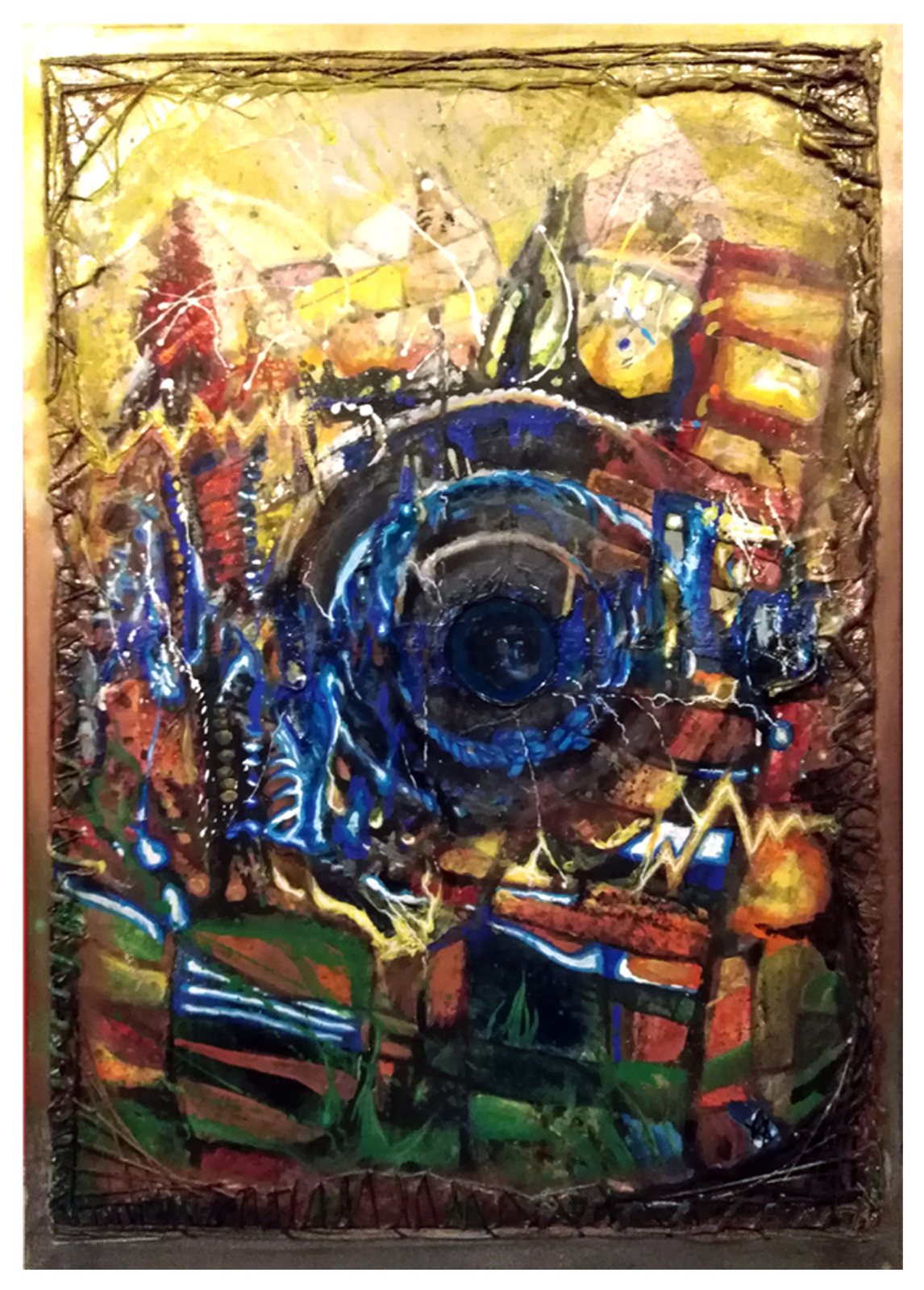
Stev Varga was born in 1978 in Altdöbern, a small town in Lusatia where the land itself keeps being rewritten — villages moved, pits dug, lakes made. Maybe that is where it starts: he has never trusted a surface to stay the way it was given to him.
He taught himself the long way — comics first, drawn panel by panel and then bound by hand, because in 2004 he trained as a bookbinder. That craft never left the work. Look closely and you find a binder's habits everywhere: cotton and polyester stitched over carton, layers glued and fixed and sewn, paintings built the way books are built — to be opened again and again, and to hold.
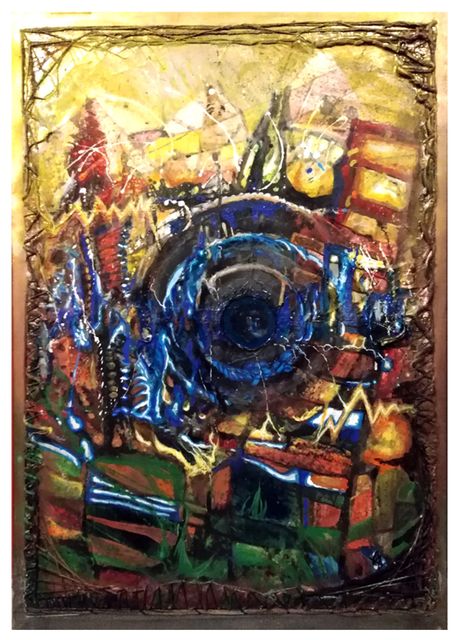
A painting by Varga is rarely just a picture; it is an object with a body.
He paints with whatever carries meaning: acrylic, graphite, ink — and coffee, poured and stained into hemp paper until the ground itself looks like memory. Glass, metal, salvaged wood.
For nearly twenty years he has given the craft away as fast as he learned it: the Comic & Drawing group at a Cottbus school twice a week since 2008, creative coaching at the Kunst.Fabrik, workshops in hospitals, drawing with children at market days, and since 2016 a weekly open evening at the Humi Youth Club. Half of Cottbus has, at some point, sat at a table while Stev walked around it saying: draw it the way you see it, not the way they told you it looks.
His studio is a working room and an open door. People come to talk as much as to look; painting happens between conversations. When the BTU researchers spent time there, they called it a dynamic cultural hub, community meeting point, and safe space — its very existence an act of performative resilience in Cottbus.